

In the event of Super Mario Galaxy 2 coming so close to it's release date (May 23rd 2010), I thought I would post one of my microthemes for a Communications Studies course I did, pertaining to video games (greatest course I've taken at University). Now it's slightly more academic, and in fact may be too academic, but that's not necessarily bad. Maybe the way video gaming needs to be analyzed is on a new level; a critical analysis of video games, including the nature and practice of play, hardware and other externalities, formal qualities, narrative structure and genre, simulation and realism, spatiality and property, gender and identity, authority and authorship, war and violence. Move the analysis of video games beyond deterministic arguments and incitements to moral panic towards an analysis of video games as part of a cultural field of discourses, forces, relations, processes, objects and fields.
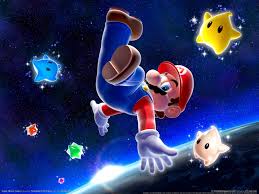
When examining the top level of reception and operation for Super Mario Galaxy, in terms of the video game model by Nick Montfort (the other four categories being: Platform, Game Code, Game Form, and Interface) it can be seen as a complete success on both fronts. When a player attempts to draw meaning from Super Mario Galaxy, it is fairly easy, since the narrative or storyline falls basically under the same elements as all of the previous Super Mario titles. Initially, players often have an appeal to the video game because they are able to identify as heroes on a fantasy quest (Sherman 244). With Super Mario Galaxy in particular, you get to travel away from Earth and into new galaxies. This is how Super Mario Galaxy sets itself apart from the rest of the Super Mario titles; Mario has to travel to outer space, exploring new worlds and being outfitted with new power-ups (such as the Fire/Ice Mario, Rainbow Mario, Boo Mario, Spring Mario and Bee Mario) to save Princess Peach once again from Bowser, who has taken her and the entire Mushroom Kingdom.
This is where one of the only problems I found occurs with the reception of the game. The problem is that there is constantly this narrative of a journey to save the princess (Sherman 246). This journey to save the damsel in distress causes the protagonist to always be male, which equals gender inequality (Ray 21). The female is deemed helpless and unable to help herself, leaving it up to, an everyday man (a plumber in the case) to save the day. This is initially seen with the release of Donkey Kong in 1984. The main moustached character, named Jumpman (who later becomes Mario), is trying to save his girlfriend, Pauline, from a massive gorilla (Ray 19). This then is the storyline from here on in; the antagonist becomes Bowser, and the damsel in distress becomes Princess Peach.
I believe these unequal gender overtones were present in most games and still are present in Super Mario Galaxy, but it has come to be accepted in a more easygoing and interactive style. I believe one reason for this acceptance is because of the emergence of the Super Smash Bros. series. Specifically Super Smash Bros. Brawl, which included plenty of female characters, including Princess Peach. She could entirely handle her own on the battlefield, and in most cases, be the last one standing when fighting Mario or even Bowser. A second reason is because Super Mario Galaxy relies upon the superstar nature that revolves around the game (Stremerch 89). Each gaming system (platform), be it Xbox 360, PlayStation 3, or Nintendo Wii has their all-star line ups which continues to carry on across platform upgrades. Microsoft has their titles like Halo, Sony has their titles like Resistance, and Nintendo has their titles like Mario and Zelda (just to name a few).
This is one of the major reasons why the reception of Super Mario Galaxy went over so well globally, and caused sales to soar. It already has its roots firmly in the gaming market and essentially everyone previously had prior knowledge and or game play experience of the title. Super Mario Galaxy on a social and cultural level also maintains it’s nostalgic and fun to play nature that is so well known throughout the series. It also pays homage to the classical Mushroom Kingdom faces and places that had only previously been seen in Super Mario 64, as well as take an old, yet loved, gaming style and make it new again on the Nintendo Wii (Nintendo Power). One of the ways this old style is made new is by adding co-operative play (“Co-Star Mode”) to the operation of the game. A second player can play alongside Mario (or Luigi, after completing the game with Mario), through collecting Star Bits, making Mario jump, and shooting enemies to assist. This allows for the attempt to make use of the Motion Sensory on the Wii.
Also another way to judge the successfulness of a games reception and operation would be to see how well it had done award wise, as well as looking at its overall ranking. In 2007 Super Mario Galaxy won many “Game of the Year” awards, and also ranks as the number one Wii platform game as seen on IGN, Gamespot, TopTenReviews, and Nintendo Power (Nintendo Power). Overall, Super Mario Galaxy is just an excellent game that can be played and enjoyed by any gender or any age and will always have a lasting impact in the gaming world. Works Cited
“Best of 2007.” Nintendo Power. (2007).
Ray, Sheri G. “Evolution of Female Characters in Computer Games.” Gender Inclusive Game Design: Expanding the Market. (2004): 18-35.
Sherman, Sharon R. "Perils of the Princess: Gender and Genre in Video Games." Western Folklore. 56, no. 3-4 (1997): 243-58.
Stremersch, Stefan. "The Effect of Superstar Software on Hardware Sales in System Markets." Journal of Marketing. 73.2 (2009): 88-104.
Super Mario Galaxy, Nintendo Wii. November 14, 2007.



Post a Comment